Alternative drying in a new way
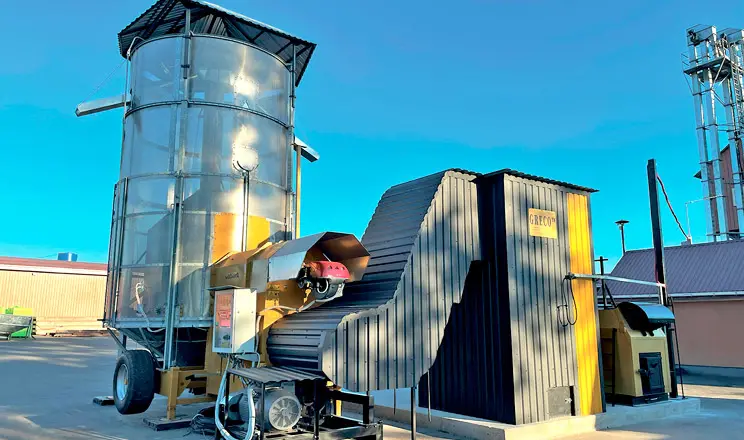
Progress in the production of solid fuel heat generators makes them safer and more suitable for the most demanding products.
Unfortunately, natural gas has ceased to be a reliable source of energy despite its convenience and environmental friendliness. The reason is the instability of supply, as well as the price, which is unpredictable. However, any business, and agricultural business in particular, strives for stability and energy independence. So it is quite understandable why Ukrainian elevators have been more actively buying solid fuel heat generators in recent years, among which a record number was ordered from the Vinnytsia manufacturer Greco Group.
Ukrainian legislation is increasingly being brought into line with EU requirements, and farmers are striving to meet international quality standards. Greco Group responded swiftly to these trends and developed a semi-heat exchanger that prevents combustion by-products from affecting the grain. The first such device was installed at Ukrprominvest Agro for drying waxy maize, from which starch is produced (the product is exported to the EU for the manufacture of baby food). Semi-heat exchangers are now installed at TAS Agro, Korolivskyi Smak and other companies.
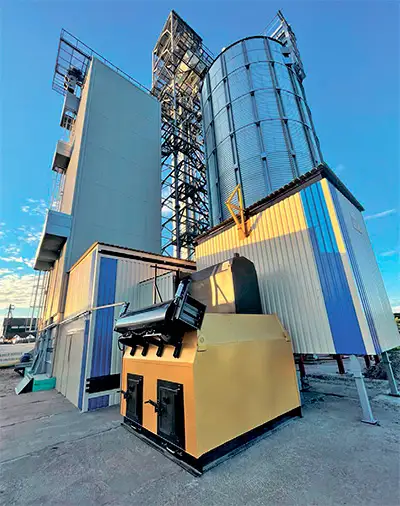
The principle behind a semi-heat exchanger is that the vast majority of the heat transfer medium consists of heated outside air. Only a small proportion of the flue gases pass directly through. Their concentration in the overall flow is minimal, so the product fully complies with sanitary requirements for food-grade raw materials. Thus, the semi-heat exchanger makes it possible to safely dry any grain and even niche crops.
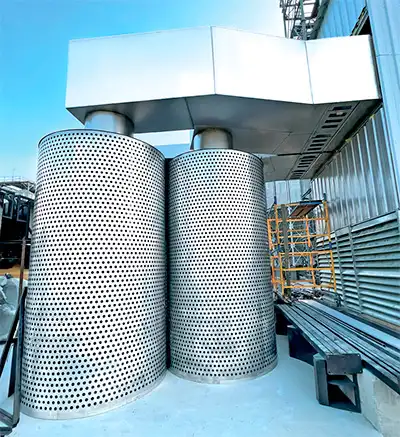
Greco Group decided against developing a full-scale heat exchanger, as it is too complex to operate and requires regular maintenance and cleaning. The American concept proved more suitable: ‘The simpler, the more reliable and cost-effective’. That is precisely why the entire range of heat generators with capacities from 3 to 20 MW requires no additional staff. Systems with full-scale heat exchangers need to be periodically shut down and cleaned, and such stoppages in the middle of the harvest season can not only disrupt the smooth operation of the grain elevator but also negatively impact crop harvesting at large enterprises. For example, agricultural holdings concentrate a large amount of machinery during the harvest—combine harvesters, tractors with loaders, and vehicles—which must operate without interruption. However, if a dryer stops for 10 hours every three days just to clean the heat exchanger, and then takes 3–4 hours to get back up to speed, what sort of productivity can we expect? A semi-heat exchanger does not require equipment shutdowns and cannot burn out, so its operation is reliable and cost-effective.
The dryer’s operating mode depended on the operator’s actions, and errors occurred from time to time. For example, at one plant, instead of drying maize with a moisture content of 21% using a heating agent at +110 °C, the operator increased the temperature to +140 °C. As a result, the owner ended up with around 14,000 tonnes of over-dried maize, but only discovered this several months later when he began selling the batch. Thus, the operator’s incorrect actions led to significant losses.
To avoid such situations, a remote monitoring system has been implemented, which allows for real-time monitoring of the drying process, the receipt of immediate alerts, and the storage of equipment operation logs. At any time, the owner can view all the dryer’s performance indicators and, if necessary, make adjustments, thereby avoiding losses. CCTV cannot monitor drying temperature and fuel consumption, whereas the monitoring system provides all the necessary information and sends alerts if limit values are exceeded.
Greco Group calls the full integration of solid fuel heat generators into grain dryers the biggest achievement this year. When a sensor is activated in the dryer, the heat generator reacts exactly as a gas burner would. This significantly reduced the influence of the human factor on the quality and efficiency of drying.
Recently, many enterprises have started to use wood chips, corn cobs, rapeseed, soybean or pea pellets, grain waste and often produce pellets themselves. This additionally reduces the cost of drying and provides workers with work in the winter period. However, non-standard fuel has worse flowability characteristics and requires additional equipment that prevents the material from "hanging" in the bunkers. Therefore, "Greco Group" developed appropriate mechanisms for working with "inconvenient" fuel and thus expanded the capabilities of its own heat generators.
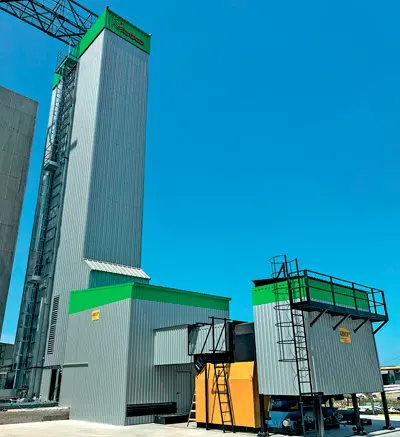
Farmers often view the switch to alternative fuels as something of a risky move. This is due not only to the increased complexity of the drying process, but also to a lack of experience in working with a new heat source. However, in reality, Greko Group’s solid-fuel heat generators provide energy independence, and there is also the option of retaining the gas infrastructure as a backup heat source. ‘The Alternative’ allows you to avoid waiting for contracts to be signed and permits to be obtained, to save time on purchasing gas, and to operate exactly when you need to. The heat generator reaches operating temperature in 20–40 minutes, after which drying can begin. Many have faced a situation where a few per cent of moisture needs to be removed urgently before a batch is shipped, but no gas quotas have been ordered. Depending on the location of the grain elevator and the capabilities of the gas network, this can become a problem. With solid fuel, there are no such complications — you simply press a button and start drying.
Just four years ago, no one could have imagined that solid fuel heat generators would become so widespread. However, they are now used by hundreds of elevator and industrial enterprises. This saves money and reduces dependence on gas. At the same time, the equipment is modernized, its operation is simplified and becomes even more efficient. The company "Greco Group" sets a certain level of technological standards in this field, offering innovative solutions and reliable partnership. That is why more and more agricultural enterprises choose Greco Group equipment for their elevators.