A solid fuel boiler and farmer's ingenuity made grain drying several times cheaper
A solid-fuel boiler and a farmer’s ingenuity have made grain drying several times cheaper
Just a few years ago, for most farmers, grain drying remained a necessary step that came with its own set of constraints — high tariffs, queues at grain elevators and a reliance on gas. At the “”Kolos” owned by farmer Z.M. Tsiolkovsky” in the Lviv region, they decided to take a different path — to close the production cycle in-house and focus on alternative fuel, turning waste into a resource.
This step required not only investment, but also a willingness to experiment and take risks. Yet the very first season demonstrated that a properly designed drying system can be more than just a cost-saving measure; it can form the basis for consistent quality, flexible planning and a new approach to running an agricultural business.
How ‘Kolos’ is building a sustainable business for the long term
The “Kolos” farm, run by farmer Z.M. Tsiolkovsky in the Lviv region, is not about scale for scale’s sake, but about well-considered decisions that have been shaped over the years. Founded back in 1994, it remains a family business to this day, where every stage of production has its own logic and continuity. Today, around 1,300 hectares of land are under cultivation, and this area operates according to a clearly structured system. The choice of crops here is no accident.
— Soya and maize are not just profitable crops, but part of a well-planned crop rotation that helps restore the soil. Maize leaves behind organic and mineral residues, whilst soya enriches the soil with nitrogen. At the same time, the different nature of these crops — one dicotyledonous, the other monocotyledonous — minimises the spread of disease between crops, — explains Stepan Tsiolkovsky, son of the farm’s founder and farm manager.
When it comes to farming techniques, agricultural producers also strike a balance between traditional and modern methods. They do not plough in the traditional sense, but neither do they adhere strictly to no-till farming. Their approach is closest to strip-till: involving deep loosening of the soil, two rounds of cultivation with the application of fertiliser, and subsequent sowing.
But even with the right farming techniques, cultivation is only part of the process. At Kolos, they take a broader view – a complete production cycle that doesn’t end in the field.
“In order to complete the production cycle — from sowing to harvesting — the produce still needs to be prepared for sale. The grain needs to be cleaned, sometimes dried further, stored, and only then sold,” says the farmer.
It was precisely this realisation—that the agricultural business is not limited to crop production—that paved the way for the next stage in the farm’s development: the construction of a grain silo.
Three million for the pipeline or independence – that is the choice facing the farm
We had to decide what equipment to choose and, most importantly, decide on the type of fuel. A key factor in ruling out gas was not only its price, but also the cost of connecting to the mains.
“The gas pipe was nearby; we needed to lay about 300 metres of pipework. But according to initial estimates, that would have cost us a pretty penny—around 3 million hryvnias,” recalls Stepan Tsiolkovsky. “And that’s not even all the costs…”
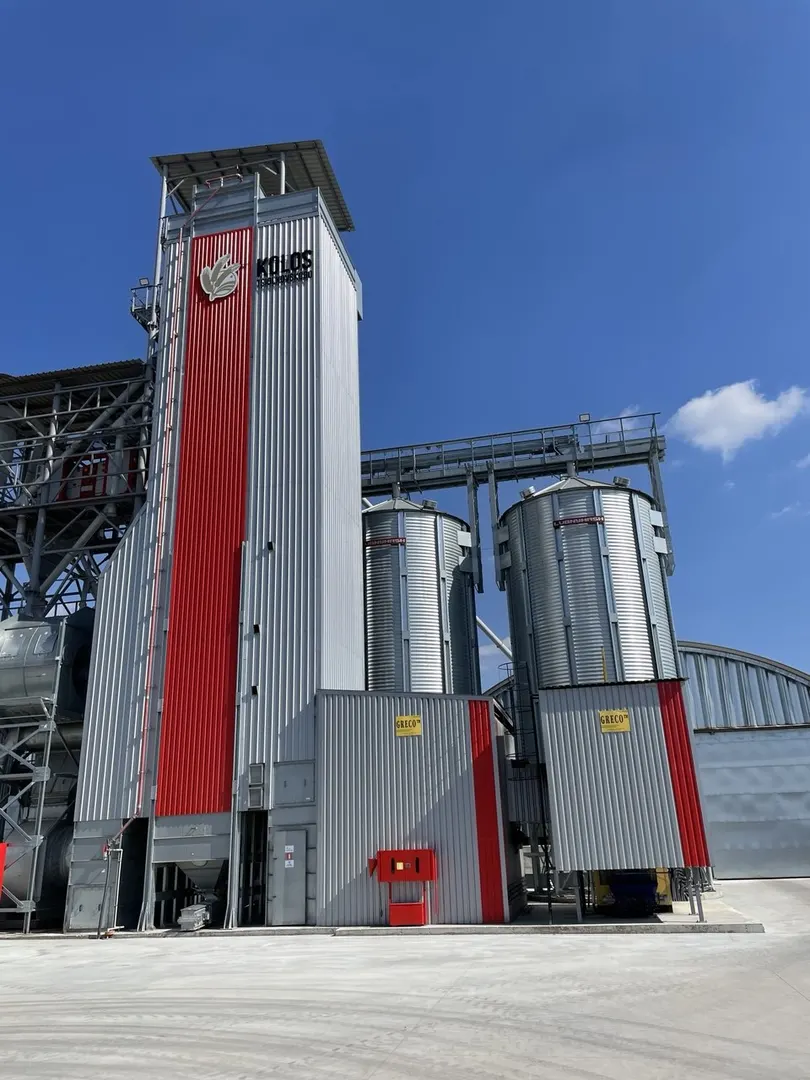
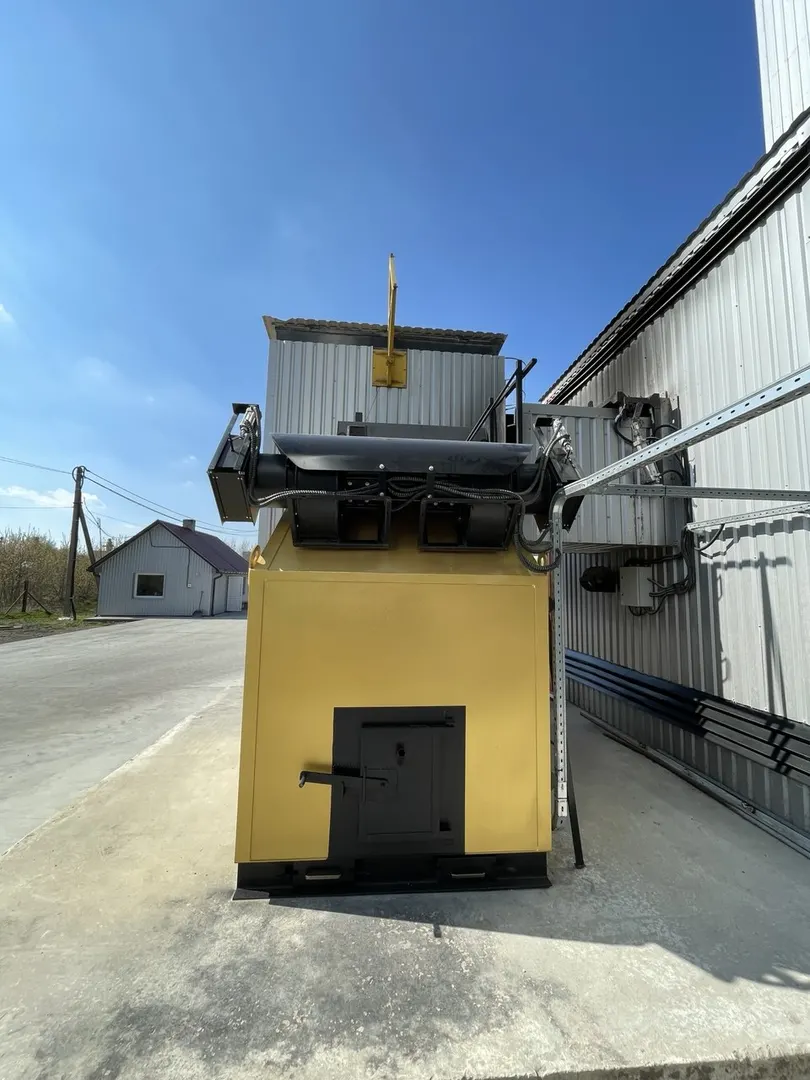
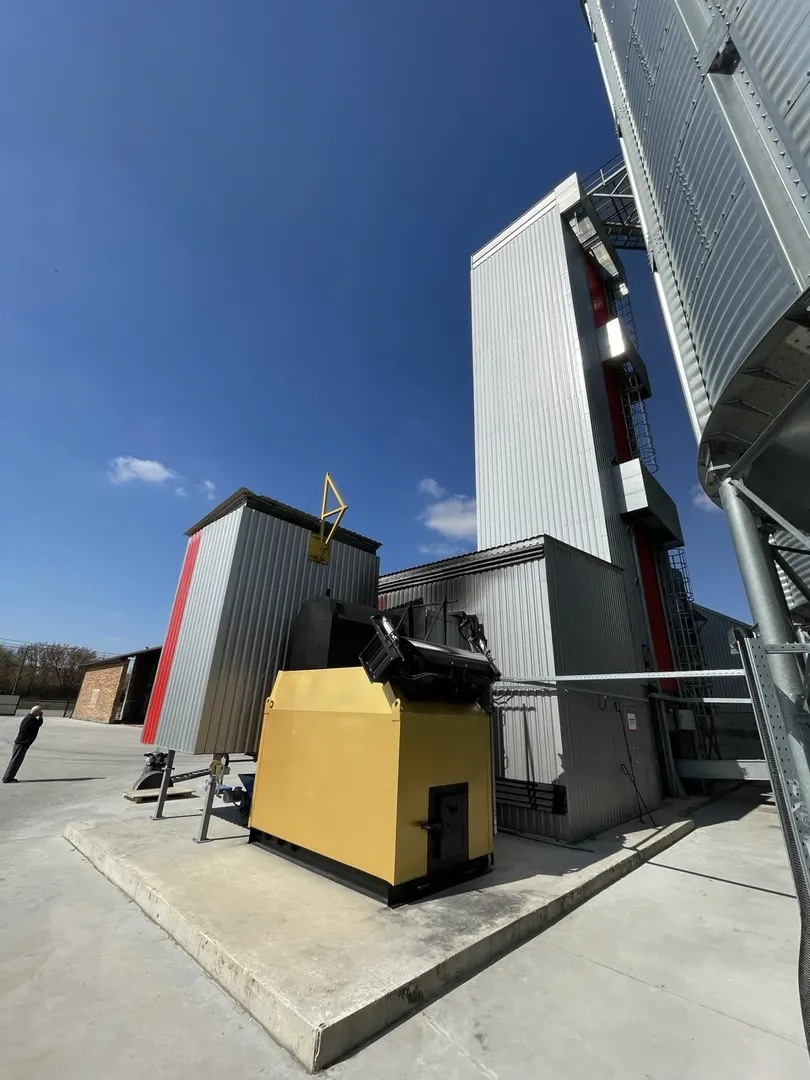
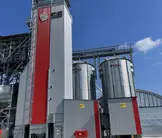
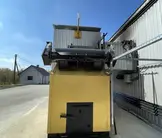
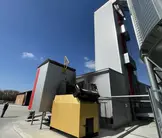
The cost of such a solution was exorbitant, and at the same time it did not provide the farm with the flexibility offered by the use of alternative fuels. So, after analysing various options, the farmers installed a new grain drying complex, comprising a Ukrainian-made ‘Lubnimash’ grain dryer and an automatic solid-fuel heat generator from the Greco Group, designed to run on wood pellets, the cost of which ranged between 10,000 and 13,000 hryvnias per tonne.
At the heart of this integrated, well-coordinated system lies the drying complex’s thermal module Greco Group which has been seamlessly integrated into the grain elevator’s structure and responds to the process’s requirements in real time.
— Our solid-fuel boiler is fully automated and operates in tandem with the dryer as a single integrated system. It is programmed to maintain set temperature levels and regulates the fuel supply automatically: if, for example, a temperature of 50–60 degrees needs to be maintained, it ensures precisely that level of heat without any fluctuations. The biofuel power plant adapts precisely to the drying conditions — grain moisture content, crop type and the required operating mode — explains Stepan Tsiolkovsky.
According to the farmer, a high level of automation plays a crucial role here, as it means that fewer staff are needed to run the facility without compromising control over all the technical parameters.
— Everything runs automatically here: one person is enough at night, and two during the day. We simply monitor the process without interfering with it.
This is a perfectly realistic scenario for a solid-fuel heat generator, and it is particularly valuable that the equipment adapts well to different types of fuel.
— According to our calculations, we needed around 300 tonnes of pellets per season, but in reality we only used about 50. We replaced the rest with our own fuel — corn waste: cobs, crushed grain, meal and dust. We left all of this behind after harvesting and used it for drying,” explains Stepan Tsiolkovsky. He adds: “This is our know-how, which has reduced the cost of the process several times over. In other words, the cost of drying has fallen to a quarter of what we expected.
To this end, they even deliberately changed their harvesting methods, allowing more chaff to remain in the grain in order to obtain more raw material for fuel. The dried and cleaned waste was then converted into a fully-fledged energy source.
— We load the hopper — that’s about 8 tonnes of maize waste — and then the fuel is fed in automatically. Once every five days we have a scheduled shutdown for 2–3 hours — we clean the boiler and the dryer. It’s important to note that the start-up went very quickly: we were up and running by the third day; our lads learnt the ropes in three days and managed on their own from then on,” says Stepan Tsiolkovsky.
There is an important detail to this innovation from the farmers: the complex’s heating system easily coped with a task that was out of the ordinary for it. It was successfully calibrated to operate efficiently not only on standard pellets, but also on alternative fuel produced on-site.
— The heat generator is perfectly balanced in terms of fuel and air supply, so it operates consistently within the set parameters and fully meets the required specifications. For our farm, this is, without exaggeration, a ‘golden’ solution, — concludes the farmer.
No compromise on quality: fears that proved unfounded
Having its own dryer has enabled the farm to take a fresh look at costs that previously effectively ‘ate into’ its profits. The difference between drying on-site and using grain elevator services proved to be significant. Whilst drying at ‘Kolos’ costs around 600–800 hryvnias per tonne, these costs are several times higher when outsourced.
— Last year, in September and October, there were periods of frequent rain and waterlogged soil, with rainfall in some areas reaching 120–180% of the seasonal average; as a result, the maize arrived at the drying facility with a very high moisture content — often 26–32%. Under such conditions, drying at grain silos cost between 2,000 and 4,000–5,000 hryvnias per tonne. If farmers were paying around 8,000 hryvnias per tonne of maize, and half that price had to be spent on drying, the economics become clear. That is why many farms simply did not harvest the grain from the fields: according to our estimates, up to 40% of the maize remained in the fields until spring,” explains Stepan Tsiolkovsky.
Despite the obvious economic appeal, the farm had some very practical concerns at the outset — primarily regarding the quality of the grain after drying.
— We planned to finish processing the harvested maize in a single pass and produce a high-quality product. But we were worried about whether we could ensure proper combustion when using alternative fuel. If the process didn’t go smoothly, there could be smoke, soot and, consequently, an unpleasant odour in the grain.
This could potentially have affected the commercial characteristics of the grain. For a market-oriented farm, this was a crucial factor.
“The dryer and boiler did the job perfectly — they ran smoothly, maintaining the set temperature without any fluctuations, so we managed to get everything done in a single pass without compromising on quality,” says Stepan Tsiolkovsky, pleased with the result.
It is precisely this stability that makes it possible to operate even at moisture levels of 26–32% without ending up with cracked or over-dried grain. At the end of the season, the farm produced high-quality, sale-ready produce, with no losses and no need for additional drying cycles.
— It is essential for us to maintain the standard moisture content levels, as both the storage and subsequent sale of the grain depend on this. We aim for a standard of 14.5%, but we try to operate within the 13–14% range to allow for a safety margin. We do not allow levels to rise to 15–16%, as the grain then loses its quality. At the same time, we understand that figures may fluctuate slightly during processing, but they even out during finishing and we achieve a stable average result, — explains Stepan Tsiolkovsky.
As for product sales, the farm has deliberately focused on the domestic market this season. Whereas grain used to be exported, particularly to Italy, the logistics landscape has now changed significantly: according to Stepan Tsiolkovsky’s calculations, transport costs have risen from €45–50 to €60–80 per tonne, which has had a significant impact on the final profitability. Added to this are the costs of packaging, transport organisation and customs clearance, which further increase the cost of exports.
The drying equipment, however, has more than proved its worth. According to the farmer, the facility is capable of processing between 300 and 500 tonnes of grain per day, depending on the crop and its moisture content. And although soya and maize remain the farm’s main crops, the facility’s technical capabilities are considerably broader.
— We are ready to provide services to other farms. We can dry a variety of crops, including rapeseed, barley, wheat, sunflowers, soya beans and maize.
A single system from field to dryer, or the new farm economy
A key factor in the efficiency of the complex at ‘Kolos’ has been the well-organised logistics during the harvest. From the outset, the farm adopted the principle of continuous operation of the dryer, which allows for the equipment to be loaded evenly, avoids downtime and ensures consistent grain quality. Given that the volume of harvested grain exceeds the daily drying capacity, buffer storage facilities were provided to accumulate raw materials — this allows operations to continue regardless of weather conditions and ensures the processing process is not interrupted.
— We designed the system from the outset to ensure the dryer runs continuously — this guarantees consistent quality and energy savings. During the harvest, two combine harvesters are in operation, and the volume of grain harvested exceeds what we can dry in a day, so we have two 200-tonne silos and a shed where we store the wet maize. This provides a buffer for 3–4 days of operation: even if it rains or the machinery cannot get out into the field, the dryer does not stop. In total, last season we dried all the maize — around 7,800 tonnes — in 26–28 days,” calculates Stepan Tsiolkovsky.
This approach makes it possible to integrate all stages—from harvesting to grain drying—into a single, coordinated system, where technology, logistics and economics work in harmony and complement one another.
At the same time, the installation of its own grain drying complex powered by alternative fuel was not merely an upgrade of Kolos’s technical infrastructure, but a strategic decision that transformed the very approach to production planning. The farm has effectively moved away from dependence on external services — grain elevators, energy costs and weather conditions — to a model where the key stages of grain processing are under full internal control. It was this that made it possible to review the crop structure and focus on a more technologically complex but economically profitable crop — maize.
— Now that we have our own dryer, we’re planning our production differently. Previously, we divided our fields into three sections and rotated crops as follows: two years of soya and one year of maize, meaning we grew more soya. We’ve now increased the area under maize — this year it’s 850 hectares, whilst we’ve sown 550 hectares of soya. We know we can process the grain to a high standard, so we plan to dry around 10,000 tonnes of maize. We hope to avoid drying the soya, but it will still need cleaning,’ explains Stepan Tsiolkovsky.
These figures are more than just statistics. They demonstrate how, thanks to careful planning and technology, the farm has been able to establish a stable process in which quality, speed and cost-effectiveness work in harmony.
A partnership that can withstand seasonal peaks
The first season of operation for the new grain drying complex at the ‘Kolos’ Farm, owned by farmer Z.M. Tsiolkovsky, served not only as a test of the technology but also as a test of the reliability of the entire system — from the equipment to the after-sales support. And, as Stepan Tsiolkovsky admits, they did have to contact the specialists, but this was more a part of the adaptation process than a sign of critical problems. The farmers were pleasantly surprised by the responsiveness of the Greco Group service team. According to Tsiolkovsky, the support was not merely formal, but genuinely prompt.
— During the process, we received advice, including on the use of maize waste in a solid-fuel heat generator from the Greco Group, — the farmer points out. — And a few other minor details. When one of the sensors broke down, just two hours after we contacted them, the company’s specialists brought and installed a new one, — recalls the farmer.
This level of service provided the farm with further evidence that it had made the right choice. The partnership did not end when the season finished — the system’s main heating unit needed to be prepared for the next operating cycle, and the manufacturers took on this task.
— This involves a thorough cleaning and refurbishment of the working parts, — says the farmer. — As a result, the equipment is effectively restored to ‘as new’ condition and ready for the next season.
Drawing on his many years of experience, Stepan Tsiolkovsky knows that it is not easy to find a reliable partner. The farmer is genuinely delighted that everything has worked out with the grain drying complex and, in particular, with the introduction of an alternative energy source.
— I would wholeheartedly recommend Greco Group’s solid-fuel boilers to colleagues who are currently in the process of selecting alternative-fuel drying equipment — the quality, service and mutual understanding are all of the highest standard, says Tsiolkovsky after a year of operating the equipment and working with the manufacturer.
This decision, however, was not an easy one. That is why the farmer fully understands the doubts and anxieties that every farmer experiences in this situation. Before settling on a specific solution, the ‘Kolos’ farm went through a long process of research and testing.
— We spent a long time choosing, analysing various options, visiting other farms, and seeing how it worked in real-world conditions, and to be honest, we weren’t entirely convinced at first. But in the end, we didn’t just get a piece of equipment, but a balanced system where the dryer and heat generator work as a single unit — and in fact, all the economic benefits and efficiency are now on the farmer’s side. Ultimately, this solution became not just a technological upgrade, but a turning point that changed the approach to the entire production process and the farm’s economics,” concludes Stepan Tsiolkovsky.
The experience of Z.M. Tsiolkovsky’s ‘Kolos’ farm demonstrates that investing in in-house grain processing and switching to alternative fuels can not only reduce costs but also provide full control over the quality and pace of production. From crop rotation to the final sale of grain — every stage now operates within a single, internally balanced system. This gives farmers a strategic advantage, allowing the farm to operate with confidence even in challenging market and weather conditions.